The Biggest Gap in MEDDPICC is Compelling Events
Compelling Events are the most important qualifier of any sales pursuit, especially when you are chasing new logos, yet it is not included in MEDDPICC.
That’s ok. MEDDPICC already has enough letters. We aren’t saying it needs to change, but we are saying that you MUST obsess over compelling events, even if it’s not in MEDDPICC.
What’s a Compelling Event?
A compelling event is a dated event in the buyer's world that carries a named consequence if they do nothing. Amount and Stage describe the deal and your process; the close date is a prediction. The compelling event is the evidence behind that prediction, which makes it the load-bearing field of the pipeline: pull it out and the close date is a guess.
If you have a Compelling Event field in your CRM…GREAT! Many, if not most, do not formally track a compelling event on the opportunity record. Add it today if you don’t have it.
What you will find is that your reps will be great at filling in that Compelling Event field, but most of those entries would not survive 30 seconds of scrutiny.
What’s a qualified Compelling Event?
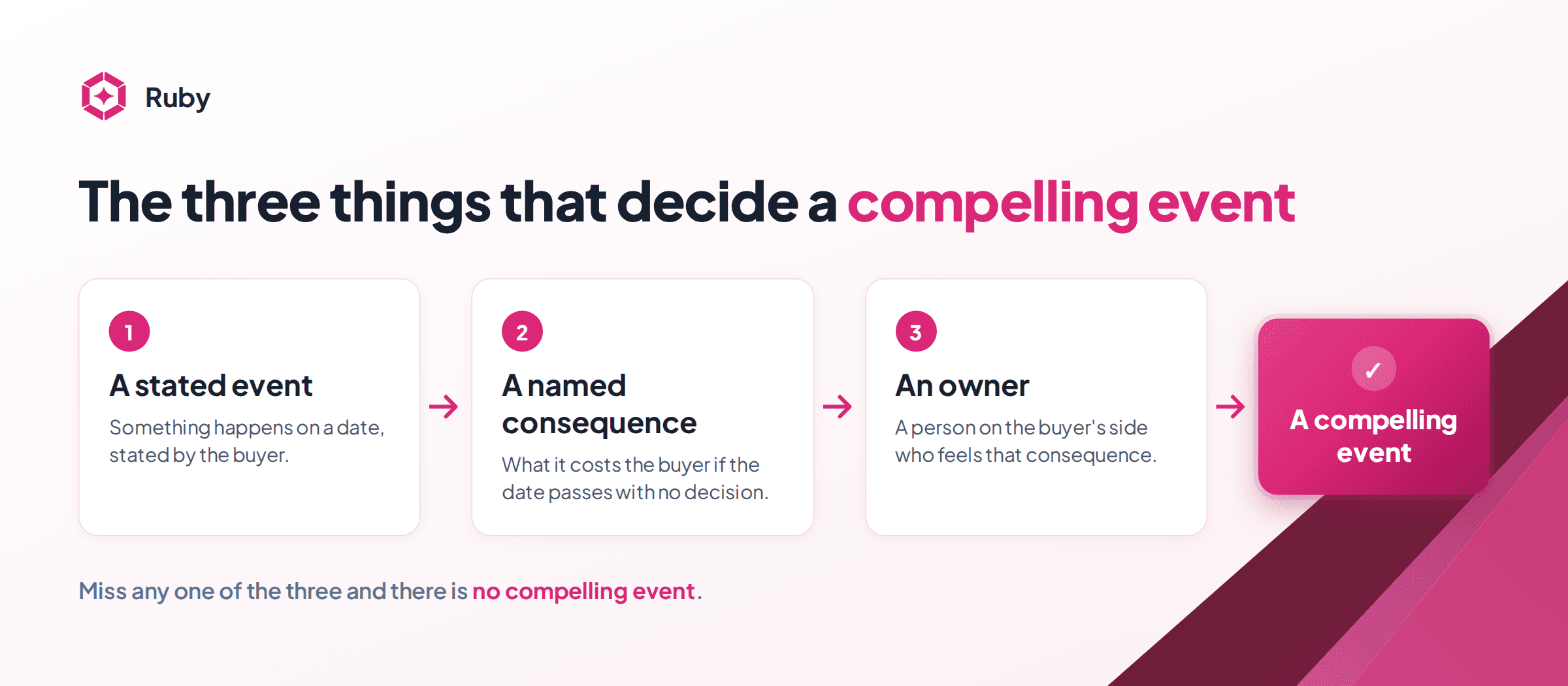
A real compelling event has three parts, and it needs all three:
A stated event. Something happens on a date: a contract lapses, a fiscal year closes, a board meets, a system gets decommissioned. Stated by the buyer, not inferred by the rep.
A named consequence. What it costs the buyer if the date passes with no decision. "Contract lapses 31 March, and with no action the team defaults to a 12-month extension with the current vendor" is a consequence. "They want to move fast" is not.
An owner. A person on the buyer's side who feels that consequence and said so. A consequence nobody owns is a consequence nobody will act to avoid.
A Competitor Renewal Date Is not a Compelling Event
The most common false positive in the field: the renewal date.
A rep asks "when does your current contract end?" and the buyer answers "September." Boom - compelling event right? The AE updates their CRM with a compelling event that reads "renewal in September." It fails the test twice: no consequence was named, and nobody on the buyer's side owns the outcome. A date the rep had to extract is not an event the buyer is driving toward.
Now the same date, said differently: "Our agreement lapses September 30, procurement confirmed there's no auto-renew, and if we haven't picked a replacement by then my team carries the migration into Q4 audit season." Same renewal, but now it carries a stated event, a named consequence, and an owner who used the word "my." That one holds a close date up.
We built this distinction into Ruby's classifier, and the engineering forced us to be honest about it. Ruby reads every call transcript against the CRM record and writes a compelling event to the deal only when the evidence clears a bar: a stated event carrying a named consequence and an owner lands, while a phrase that merely sounds urgent has to pass a much stricter test before Ruby writes it at all. A renewal date mentioned in passing produces an empty field. Teaching software the difference is a useful exercise, because it proves the difference is real: if a compelling event can't be written down as event, consequence, and owner, there isn't one.
No Compelling Event = No Decision
Matt Dixon and Ted McKenna's analysis of 2.5 million recorded sales conversations found that 40 to 60% of deals are lost to no decision rather than to a competitor.
A missing compelling event will almost certainly lead to a no-decision. The chain runs in one direction:
No compelling event means the buyer has no deadline. A buyer with no deadline defaults to the status quo, because the status quo is free and every change carries risk. The rep, who does have a deadline, then manufactures urgency the only way a seller can: a discount that expires at quarter end. The buyer, correctly reading that the deadline belongs to the seller and not to them, waits. The deal slips, the discount survives into next quarter anyway, and the close date moves again, which is where this post started.
Every stage of that chain is a symptom that shows up in forecast reviews as its own problem: slippage, quarter-end discounting, stage inflation. All three trace back to the same missing field, because the deal never contained a date that mattered to the buyer.
How to use MEDDPICC to qualify Compelling Events
Compelling event is not a letter in MEDDPICC, and that makes it easy to skip: no checkbox, no score, no section in the deal review template. But it is the connective tissue between two letters that are there. Identified Pain tells you why the buyer should act, and Decision Process tells you how they will. The compelling event is the why now that turns the first into the second, because pain without a date is a roadmap item.
Ruby AI treats it that way in scoring: Ruby scores every compelling event it assesses on a 0 to 100 urgency scale, and a deal that still has no compelling event after three meetings gets flagged as a high-severity concern, a flag that drags down the same health score that MEDDPICC evidence, meeting quality, and stakeholder engagement build up. A deal with strong pain and a blank compelling event reads as a deal that could close and has no reason to. The mechanics of how Ruby classifies transcripts into that field, including the two tests a phrase has to pass before it gets written, live in how Ruby writes deal intelligence into HubSpot.
Read your top 10 deals tonight
The audit takes 20 minutes. Open your 10 largest open deals and read the compelling event field against the three-part test: stated event, named consequence, owner.
Score each one 0 to 3. A field that names all three is a 3. "Renewal in September" is a 1. "Strong interest from the champion" is a 0, because interest is not an event. Then look at the deals scoring 0 or 1 and ask one question about each: whose deadline is the close date, yours or theirs?
If the honest answer is yours, then the close date is not a forecast at all, just the rep's deadline written into the buyer's future. The fix is a discovery question on the next call, not a better date: "what happens on your side if this isn't solved by September 30, and who feels it?" Either the answer upgrades the field to a 3, or you've learned the deal belongs in next quarter's pipeline, which is also a forecast improvement.
Frequently Asked Questions
What is a compelling event in sales?
A dated event in the buyer's world that carries a named consequence if no decision gets made, owned by someone on the buying side who feels that consequence. All three parts are required. A date without a consequence, or a consequence without an owner, does not compel anything.
Is a compelling event part of MEDDPICC?
Not as a letter. It sits between Identified Pain and Decision Process: pain explains why the buyer should act, the compelling event explains why now, and the decision process explains how. Some teams track it as a ninth element; Ruby scores it separately and flags a deal that still has none after three meetings.
What is the difference between a compelling event and a close date?
A close date is the seller's prediction. A compelling event is the buyer's deadline. When a deal has both, the close date sits shortly before the compelling event and holds. When it has only a close date, the date moves, because nothing on the buyer's side anchors it.
How do you know if a compelling event is real?
Apply the three-part test: did the buyer state the event, name the consequence of inaction, and own it personally? Then check where it came from. An event the buyer raised inside a next step or a pricing discussion carries more weight than a date a rep extracted with a direct question. Ruby applies the same standard automatically and leaves the field empty when the evidence fails it.